What is aPriori
Scope of the project
aPriori is a Python package designed to simplify the analysis of Direct Numerical Simulation (DNS) datasets in fluid dynamics research. Its goal is to make large, high-fidelity datasets easier to explore, post-process, and use in physics-based or data-driven workflows. The package offers a consistent interface to heterogeneous DNS formats, efficient memory management, and a growing collection of tools for data extraction, visualisation, filtering, and modelling support.
Scientific motivation
Direct Numerical Simulation (DNS) has become a central tool in fluid mechanics, turbulence, and reacting-flow research. By resolving the full Navier–Stokes equations and all relevant spatio-temporal scales [1], DNS provides highly detailed information on:
statistical and structural properties of turbulent flows [2].
the interaction between turbulence and chemical reactions [3];
small-scale mixing, dissipation, and scalar transport [4];
This level of detail comes at a cost: modern DNS runs are computationally expensive and increasingly energy-intensive. A recent analysis of DNS studies published in the Journal of Fluid Mechanics (2004–2024) showed that the largest simulations can emit up to 1000 metric tons of CO₂ — comparable to a transcontinental flight — depending on domain size, chemistry complexity and resolution [5]. Community efforts to share DNS data (e.g. JHTDB) were estimated to have avoided millions of tons of CO₂ emissions by preventing redundant computations.
These results underline two key needs:
public availability of DNS datasets, and
tools that make these datasets easy to access and reuse.
Why use aPriori?
The aPriori package is designed to streamline this entire workflow. Its main features include:
High-level abstractions (3D fields, meshes, scalar/vector variables) that hide low-level storage details.
Pointer-based data access: data are read from disk only when needed, enabling work on large datasets even on modest machines.
Built-in operations frequently required in turbulence and combustion: filtering, gradients, dissipation rates, scalar statistics, and more.
Interoperability with scientific Python tools (NumPy, PyVista, PyTorch/TensorFlow, Cantera, PyCSP).
Visualisation utilities to quickly inspect fields and slices.
Extensive documentation and tutorials, guiding both newcomers and experienced users through typical analysis patterns.
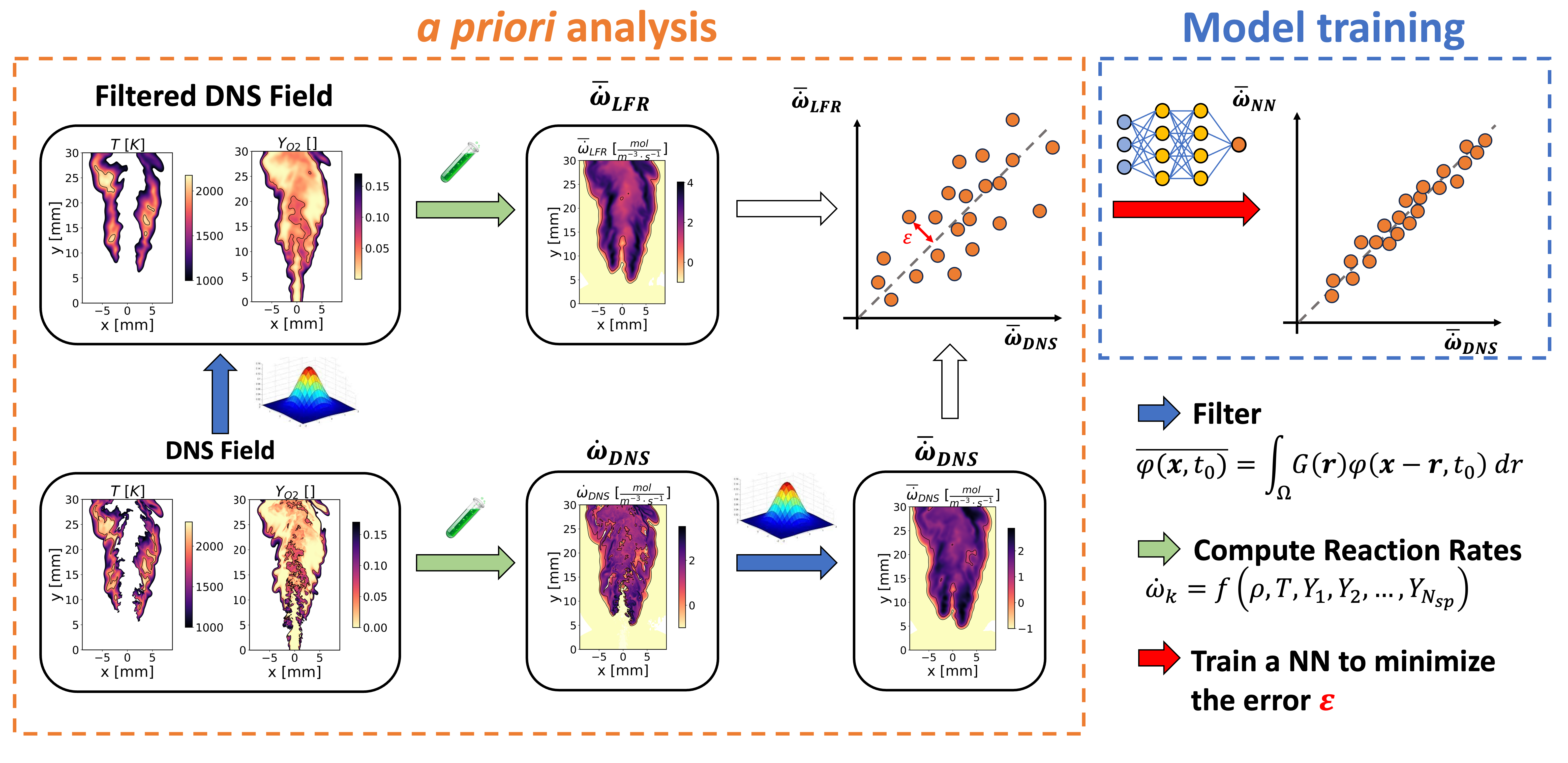
The package aims to provide a uniform, intuitive, and efficient interface to heterogeneous DNS datasets—avoiding unnecessary memory usage and accelerating research workflows in turbulence, combustion, and machine learning. As an example, the following figure displays the typical set of operations that using aPriori can be performed with a few lines of code: